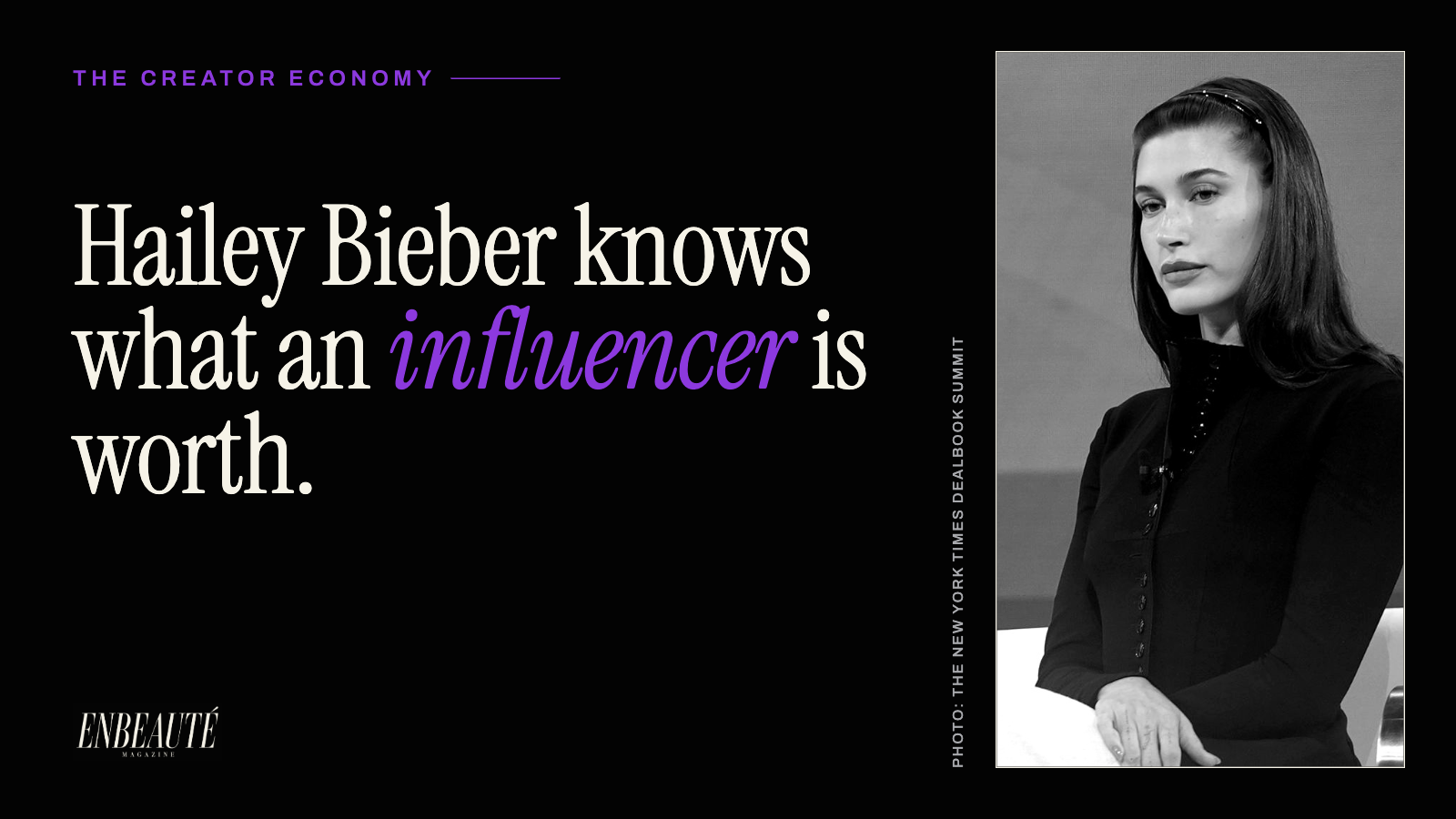
At DealBook, the Rhode founder explained the part of the business she knows best. The billion-dollar case study is in what she and her team did with it.
“Rhode is me, and I am Rhode.”
At the DealBook Summit, Andrew Ross Sorkin asked Hailey Bieber what she thought she understood that others had missed. He’d just pointed out that plenty of people had celebrity and followers without creating a brand like Rhode. I heard her answer as a creative director. She talked about the products, the packaging, the branding, the storytelling, and inviting people into a world that felt like hers. She was explaining why someone would want a piece of Rhode in the first place.
The backlash came after a later exchange. Bieber said a billion dollars was the minimum she’d sell for, and the exchange that followed turned on “a certain sense of delusion.” Critics heard a founder who couldn’t explain why her company was worth that much. A founder should be able to make the financial case for her business. I think her opening answer explained something that belongs in that case. She knew why people would pay attention to Rhode and how to give them something they’d want to buy. Her choice of partners helps explain how that instinct became a business.
That’s the influencer business model at its most effective. People watch how you get ready, what you carry, and what you reach for often enough that your preferences start shaping theirs. Bieber said she teased Rhode on YouTube and Instagram for about two years while the products were still in development. She wanted to earn trust with the beauty community before she had anything to sell. By launch, she could give that audience a way to participate. A peptide lip tint is a much easier way into Hailey Bieber’s world than whatever she’s wearing in the rest of the photo.
The lip gloss was also a prop.
I read Rhode’s appeal through the eyes of an 18-to-24-year-old shopper. The lip case makes the strategy especially clear. Your phone is already in your hand. Put the lip tint on the back and suddenly a beauty product has a recurring role in your mirror selfies, your getting-ready videos, and your friends’ group chats. Rhode gave people a reason to keep the product visible after they bought it.
Then there’s the nostalgia. For its first partnership with another brand in 2023, Rhode teamed up with Krispy Kreme on the Strawberry Glaze Peptide Lip Treatment. That’s a very adult-sounding product name for something that smells like the flavored gloss you would’ve begged for as a kid. Rhode understood that a shopper can care about the formula and still want her lip gloss to remind her of a doughnut.
Give Lauren Ratner her credit.
The founder story gets more interesting once you follow the introductions. Lauren Ratner says she met Hailey through her husband, Michael D. Ratner, who had worked with Hailey and Justin on Justin’s documentary series Seasons. Hailey approached Michael and Lauren with the idea for a skincare brand. Michael is Rhode’s co-founder and co-executive chairman. Lauren brought experience from Reformation and Michael Kors and helped shape Rhode’s branding and marketing. Her account of the lip case gets into the consumer insights behind the product, work that’s easy to miss when the image everyone remembers is Hailey holding it.
And yes, Hailey slid into a cosmetic chemist’s DMs. Ron Robinson, the founder of BeautyStat, recalled that she reached out on Instagram after using his vitamin C products. She knew what she wanted from her skincare and brought in someone with the formulation expertise to help develop it. That’s a founder decision. How she picked the people who could execute her ideas tells me more about how she ran Rhode than any answer she could’ve given about cosmetic chemistry onstage.
At the end of the interview, Sorkin thanked her co-founders and Justin, who were sitting at a table in the room. Hailey was the one onstage. The people who helped get Rhode there were sitting a few feet away.
The real money was in ownership.
Bieber told The Wall Street Journal that lending her name to other companies had shown her how much they could gain from it. With Rhode, she said, “I have to be the majority owner.”
Rhode recorded $212 million in net sales in the 12 months through March 2025. E.l.f. closed the acquisition with $800 million in consideration, subject to adjustments, and up to $200 million more tied to revenue performance. That billion-dollar figure belongs to the deal. It tells us what a buyer was willing to pay for the company her influence helped create.
Rhode is the case study for influencers who want to turn their taste into a beauty business they own. Hailey knew what her audience wanted to borrow from her life. Lauren knew how to market it. Ron helped turn the idea into a product someone could use up and buy again. And Hailey understood the most valuable part early enough to act on it. If people were going to buy into her taste anyway, she wanted to own the business that sold it to them.
So if you had her audience, would you have taken the licensing check or held out for ownership?
Hailey Bieber Knows What an Influencer Is Worth