The dresses were the frame. The bag was the painting. And the cheapest object on that runway — a leather coin purse worn as a necklace — is the tell nobody read.
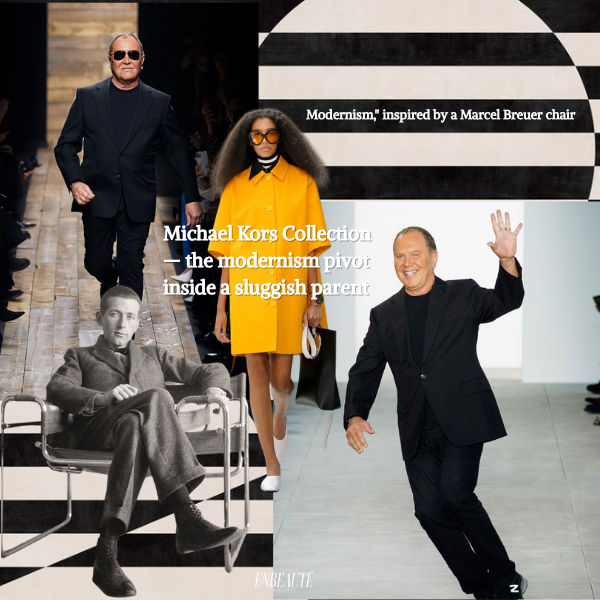
Michael Kors walked Spring 2027 into the sculpture garden at the Museum of Modern Art and called it a study in modernism: Calder, Ellsworth Kelly, Carmen Herrera, Josef Albers, a Marcel Breuer chair on the mood board. Every review that hit before lunch led with the art. "Chic optimism," Kors called it — clean, architectural, the elevated everyday. The critics graded the tailoring. The tailoring is not the story.
The story is that Kors runs one of the last great accessories machines in American fashion, and this show was its campaign — dressed, deliberately, as an art-history seminar.
Read the room, then read the balance sheet
Kors moved this show on purpose. Last season he took the Metropolitan Opera House at Lincoln Center for his 45th anniversary. This season he took MoMA. Two temples of cultural legitimacy, back to back, and legitimacy is exactly what the business needs right now.
The name on the invitation is two companies. Michael Kors Collection sells runway dresses from roughly $1,790 to $6,950. MICHAEL Michael Kors sells the same silhouette, diluted and price-pointed, from about $149.50 to $179.50. The Collection tier is the picture. The accessible tier — plus the accessories under it — is the register.
And the register is under pressure. Parent Capri Holdings posted the brand down 4.7% for the fiscal year, pulled its store count from 711 to 673, and sold Versace to Prada for $1.375 billion to concentrate the company on Kors and Jimmy Choo. Capri's stated bet is blunt: accessible luxury gains ground while the top of the market prices itself out, raising tags 61% since 2019, per BoF and McKinsey. Accessories are 55.8% of Capri's revenue. Apparel is 12.8%. The 10-K says it plainly — the brand runs on a strong focus on accessories, primarily handbags.
So when Michael Kors borrows a museum to elevate the Collection narrative, he is not indulging. He is protecting pricing power on the 55.8%. The art thesis is brand equity maintenance for the machine that actually pays.
The recurring silhouettes
Give the clothes their due, because the discipline was real and it was legible on repeat.
Kors built the collection on a spine of 1960s mod cut with a hard architectural edge. The opening look set the grammar: a sculptural black tunic with a cowl collar draping into a tailored mini, an asymmetric tail down one side, no buttons, no print — pure volume, cut off against a single optic-yellow bag. From there the shapes repeated in variations. A shift sliced on the diagonal, black bodice bleeding into radiant yellow. A cocooning cape-dress split clean across the chest, ivory against midnight. A boxy leaf-green suit with an exaggerated round collar and a sharp A-line skirt. One-shoulder evening columns. Two-piece professional sets. Striped summer dresses. A single-button blazer over street-ready capris.
The through-lines: color-blocking as structure, primaries deployed like Albers deployed them, neutrals grounding sudden blocks of pigment, and a color story engineered — whether Kors says so or not — to pop in a two-inch e-commerce thumbnail. Alex Consani closed. The room agreed it was his freshest turn in seasons.
The bag strategy
Here is where the show stopped being about clothes.
The accessories were not accessories. They were the argument. Sculptural top-handle bags carried on rigid silver hoops. Leather coin purses restrung as layered necklaces. Outsize bauble rings, again and again. Beehive sunglasses doing the same color-blocking as the dresses. The runway bag was styled as an art object — a small sculpture you hold — so that the object reads as culture, not commodity.
That is the halo. The halo exists to sell the objects that never walked: the Hamilton, relaunched this season in a softer silhouette; the Bancroft satchel; the Jet Set travel line; the MKC Monogramme that Kors sketched in high school and now stamps across the wallets. Those are the pieces sitting at accessible price points, the ones a customer discovers because a sculptural cousin of theirs stood next to a Calder.
The commercial pieces
For anyone writing a purchase order, the translatable rack is clear. The boxy leaf-green suit and the diagonal color-block shift are the RTW that survives wholesale dilution. The striped summer dresses, the single-button blazer, the two-piece sets carry the workwear-adjacent volume. The one-shoulder columns handle occasion.
But the sell-through — the reason this collection exists — is the accessory program: a hero sculptural top-handle, the coin-purse-necklace as a small-leather-goods play, the statement sunglasses, the bauble rings. Order the objects styled as jewelry. That is where the money moves.
The buyer takeaway
Watch the bag names, not the dresses. Every look on this runway ships with an accessory attached, and the accessory is the product. Buy the sculptural hero for the window, buy the small leather goods deep, and price the entry object to sit exactly in the gap the top of the market left open when it hiked 61%. The dress fills the lookbook. The wallet fills the basket.
What everyone else missed
Everyone reviewed the art. Nobody priced the necklace.
The single most repeated styling move of the show was the coin purse worn as a pendant — and Kors has run that exact move before. It is not a whim. Small leather goods are the highest-margin, lowest-price object a luxury house makes, and the hardest to make feel like fashion. Style one as jewelry and cheap leather reads as runway; a $200 accessory borrows the aura of a $6,000 dress. The wallet-as-necklace is not a trend. It is a margin strategy in costume.
Pull that thread and the whole show resolves. The museum, the 45th-anniversary opera house before it, the new Collection Instagram launched the same morning to narrate the "luxury side of the business" — all of it is scaffolding around one commercial truth: Capri needs the Kors brand to feel like culture so it can keep selling handbags to a customer the rest of luxury just abandoned. The modernism is the packaging. The accessory is the product. The optimism is a forecast the balance sheet is praying comes true.
Kors also opened his preview by noting the show fell on the 25th anniversary of September 11th — he lives downtown, he remembers the day, and he framed modernism as what cities do when they reinvent themselves. That weight is real, and it is his to carry. It also happens to be the most persuasive luxury pitch there is: buy the optimism, wear the reinvention, carry it in a bag.
The generous read is available, and it has merit. This was Kors' sharpest collection in years — younger, cleaner, less dowdy than the last two. The design was not cynical. But a good collection and a commercial operation are not opposites, and pretending the clothes are the whole story is how you miss the business entirely.
The verdict: Michael Kors did not show a spring collection at MoMA. He showed an accessories campaign with excellent production values and an art degree. The dresses earned their applause. The coin purse earned the quarter.
Pull the thread on your own closet before the next show, and count how many of your "investment pieces" are actually the frame for a bag. Then meet us back here for Calvin — the house selling the exact opposite of a logo.